
A commitment to innovation and integrity
Proteowa is a pioneering firm built on scientific creativity and careful execution to redefine client satisfaction.
Expression of recombinant proteins
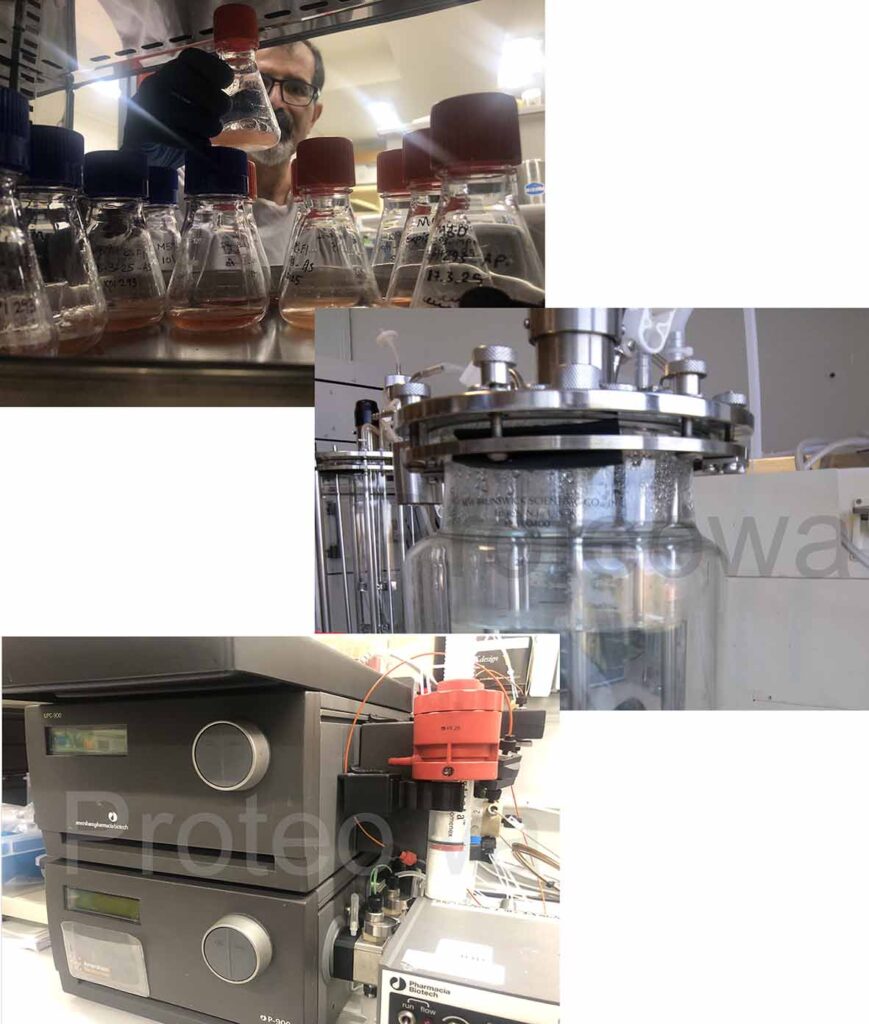
We offer both prokaryotic and eukaryotic recombinant protein expression services, followed by purification and, where applicable, formulation and stabilisation. Most expression projects are completed within 8–12 weeks.
Our approach prioritises high-yield expression with scalability in mind. From construct design to purification, every detail is carefully planned to ensure that the system not only meets the immediate needs of your project but also serves as a robust foundation for future development. Whether you require milligram quantities for research or are preparing for scale-up, our processes are designed to support a smooth and efficient transition.
Note that all proteins produced at Proteowa are for research use only and are not intended for use in humans or animals in clinical, therapeutic, or veterinary procedures.
Prokaryotic expression
Prokaryotic systems, especially E. coli, remain the most cost-effective platform for recombinant protein production—ideal for targets that do not require complex post-translational modifications (PTMs).
However, some proteins form insoluble inclusion bodies (IBs), particularly when disulfide bonds fail to form correctly. For these, we offer tailored solutions including:
- Optimised expression strategies (e.g. slowing translation rates to assist proper folding)
- Advanced in vitro refolding techniques
- Structural confirmation using analytical tools such as mass spectrometry and thermal shift assays
We have extensive experience in successfully refolding a wide range of recombinant proteins, including disulfide-rich targets such as cytokines and IGF-binding proteins. We have also expressed complex multimeric proteins such as haemoglobins in E. coli—proteins that typically require eukaryotic systems due to their PTMs and quaternary structure.
Our expression work is typically conducted in synthetic, animal-free media, with bench-top yields of 1–20 mg purified protein, or up to 1 g/L in bioreactor systems. Even proteins known to be toxic to E. coli have been expressed under our optimised conditions, though at lower yields.
We also hold proprietary technologies for improving recombinant expression in E. coli. These include methods described in our published research, which detail our approach to achieving high expression yields even in difficult proteins.
To date, our success rate in achieving expression has been 100%. For especially challenging targets, ask us about our Performance-Based Pricing Scheme.
Where needed, we offer endotoxin removal to make proteins suitable for downstream applications such as antibody production. Note that all proteins produced at Proteowa are not for clinical or veterinary administration.
Not sure where to start? We’ll help plan your expression strategy…
Eukaryotic expression
Eukaryotic expression is the system of choice for proteins requiring complex PTMs, such as glycosylation and phosphorylation. We specialise in mammalian systems, particularly HEK293 and CHO cells, which are known for producing proteins with the highest structural and functional fidelity.
We use high-yield Thermo Fisher expression systems in suspension cultures, grown in synthetic, serum-free media. Transient transfections are performed using plasmids with codon-optimised sequences to maximise output.
Typical yields from HEK293 cells are in the range of 20–30 mg monoclonal antibody per litre of culture.
Target proteins are purified using commercial-grade affinity or ion-exchange resins, ensuring reproducibility and scalability. Our purification workflows are optimised to minimise impurities and enable smooth transition to pilot- or production-scale processing.
Downstream contract research
We offer a comprehensive suite of downstream analytical and formulation services designed to confirm the correct structure and function of recombinant proteins. With deep experience in protein chemistry and structural characterisation, we assess whether the expressed proteins have the correct sequence, disulphide bond formation, and three-dimensional conformation. We also use these tools to identify buffer conditions that stabilise proteins in solution or enable successful lyophilisation. Our key downstream capabilities include:
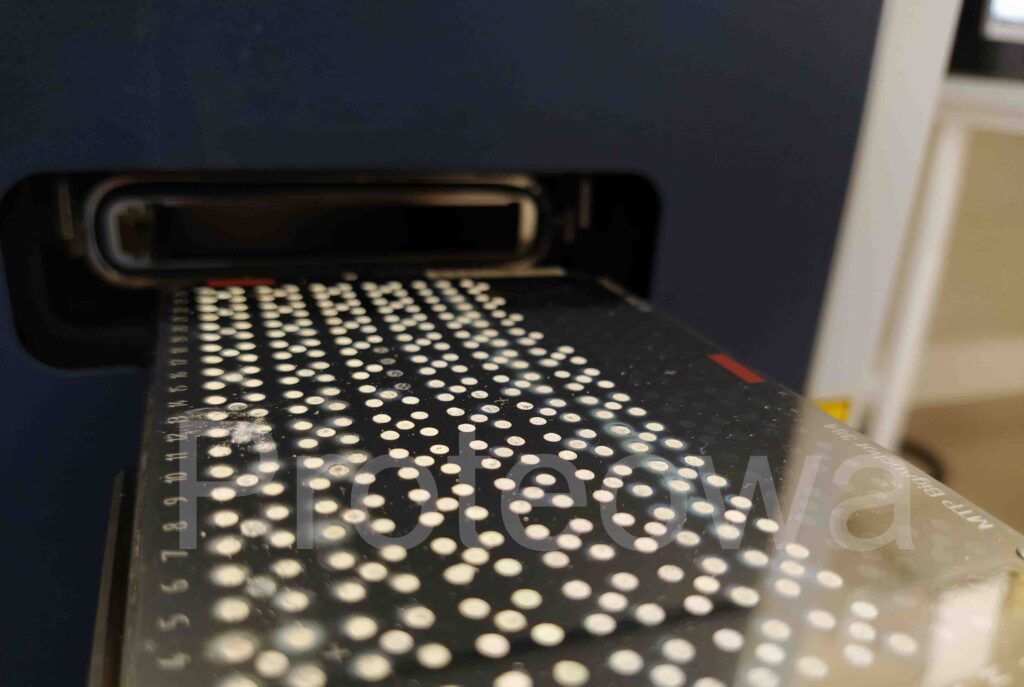
MALDI mass analysis is used for disulfide mapping, degradation analysis, adduct detection, etc

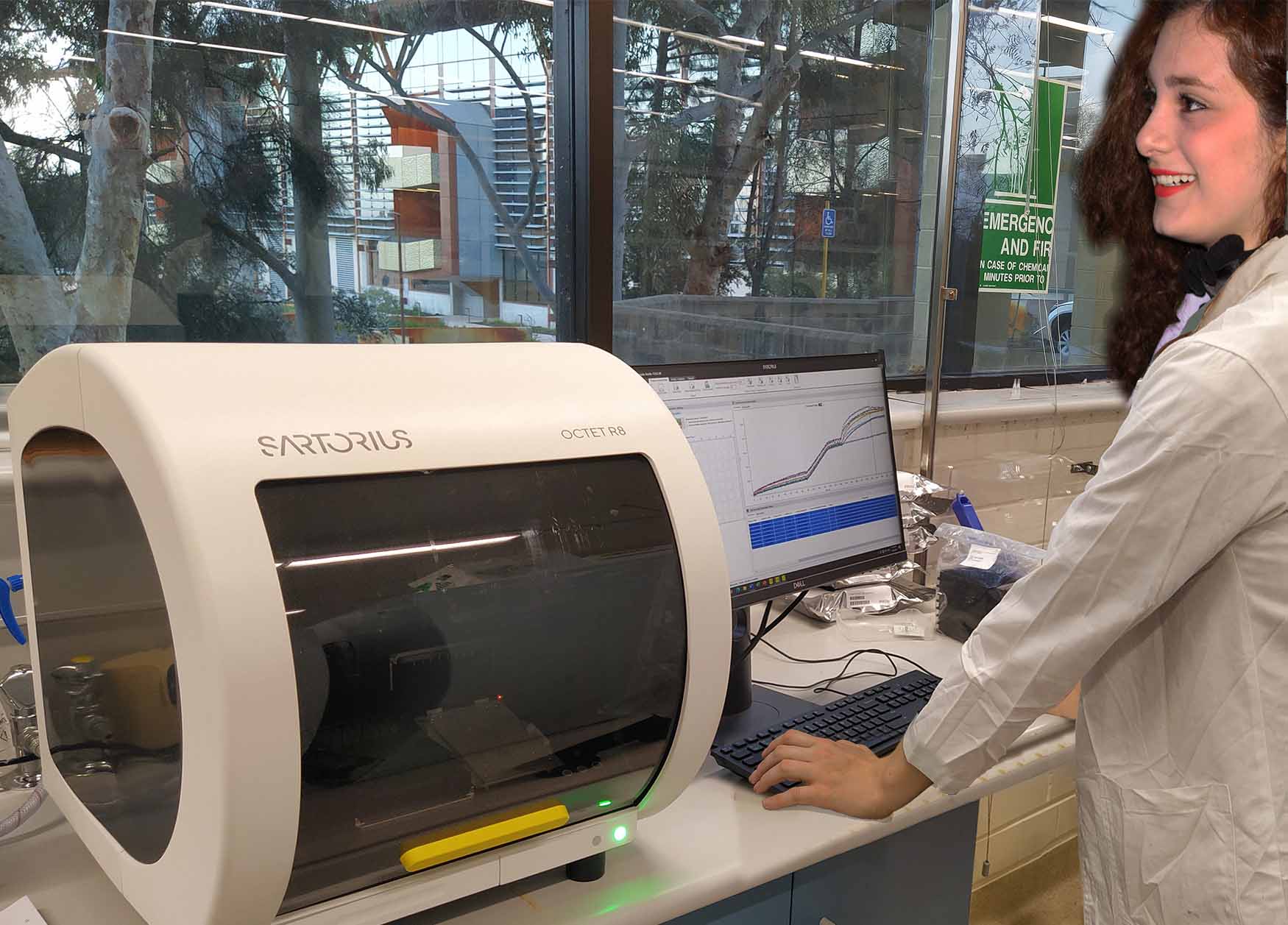
Our in-house BLI capability offers a rare level of analytical precision in a contract research setting.To learn more, visit our blog, where we post introductions, technology overviews, and practical examples of BLI applications.
- Protein characterization and general analytical techniques
We apply a range of protein chemistry tools to assess molecular identity, structure, and homogeneity. These include:- Mass spectrometry (for sequence confirmation, disulfide mapping, intact mass, and adduct detection)
- Thermal shift assays (for monitoring structural integrity and ligand interactions)
- Dynamic light scattering (for assessing aggregation state and size distribution)
- Chromatographic techniques (HPLC, FPLC)
- Electrophoretic analysis (SDS-PAGE, native PAGE)
- Biolayer Interferometry (BLI)
We use BLI to measure protein–protein and protein–ligand interactions in real time. This powerful, label-free technique provides high-resolution data on binding kinetics and affinity. It is particularly valuable for:- Assessing the binding activity and integrity of recombinant antibodies and fragments
- Confirming the correct folding and functionality of target proteins
- Supporting epitope mapping and ligand screening.
- Protein refolding
We have successfully refolded a variety of proteins from inclusion bodies (IBs) using workflows guided by analytical readouts such as mass spectrometry, thermal shift, and BLI. Refolding projects have included chemokines, cytokines, and disulfide-rich proteins such as IGF-binding proteins. Each project is tailored to the biophysical properties of the target protein. - Protein stabilization and formulation
Proper formulation is critical for protein stability and downstream applications. Whether your protein is naturally folded or refolded in vitro, we screen conditions to prevent aggregation and precipitation. If your post-storage protein recovery is low or inconsistent, chances we can help. Our formulation studies are especially valuable for:- Identifying excipients for lyophilisation
- Optimising buffers for long-term storage or assay use
- Supporting rehydration protocols for clinical or diagnostic applications.
Cnsultation
Proteowa offers tailored scientific consultation services in recombinant protein expression, purification and analysis. We have supported clients in Australia and internationally. Our projects have included optimizing protein expression and purification workflows, as well as contributing to peptidomics research aimed at identifying peptide-based molecular markers from animal fluid samples under varying health conditions. Our consultations are grounded in practical experience and are designed to address specific challenges in protein science.
“We’ve worked with Proteowa for several years across a range of protein expression projects, including multiple recombinant monoclonal antibodies and other complex constructs. Their scientific rigour and meticulous attention to detail – particularly in their recent antibody characterisation – have consistently stood out.
Proteowa is a trusted partner we’re always pleased to recommend.”
Dr Scott Bringans
Head of Research
Proteomics International